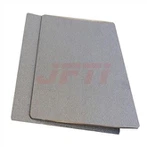
Aerospace engineering structural material titanium alloy
Titanium alloys can be divided into structural titanium alloys and heat-resistant titanium alloys, or α-type titanium alloys, β-type titanium alloys, and α+β-type titanium alloys. The research scope also includes titanium alloy forming technology, powder metallurgy technology, rapid solidification technology, military and civilian use of titanium alloys, etc. The alloy composed of titanium and other alloying elements is called titanium alloy. Titanium alloy has the advantages of low density, high specific strength, good corrosion resistance, and good process performance. It is an ideal aerospace engineering structural material.
Application: Titanium alloy is a new type of structural material. It has excellent comprehensive properties, such as low density (~4.5gcm-3), high specific strength and specific fracture toughness, good fatigue strength and crack growth resistance, and good low-temperature toughness. The corrosion resistance is excellent. The maximum working temperature of some titanium alloys is 550°C, which is expected to reach 700°C. Therefore, it has been widely used in aviation, aerospace, chemical, shipbuilding, and other industrial sectors, and has developed rapidly. The relationship between light alloy, steel, etc. (σ0.2/density) and temperature, the specific strength of titanium alloy is higher than other light metals, steel and nickel alloys, and this advantage can be maintained to about 500 ℃, so some titanium alloys are suitable Used in the manufacture of gas turbine components. About 80% of titanium production is used in the aviation and aerospace industries. For example, titanium alloy accounts for about 21% of the structural materials of the U.S. B-1 bomber, which is mainly used to manufacture the fuselage, wings, skins, and load-bearing components. The body structure of the F-15 fighter uses 7000kg of titanium alloy, which accounts for about 34% of the weight of the structure. The structural parts of the Boeing 757 passenger plane, titanium alloy accounts for about 5%, and the amount is 3640kg. The DC10 aircraft produced by the Mc-Donnell-Douglas Company uses 5500kg of titanium alloy, which accounts for more than 10% of the weight of the structure. Titanium consumption in chemical and general engineering fields: the United States accounts for about 15% of its production, and Europe accounts for about 40%. Due to the excellent corrosion resistance, good mechanical properties, and qualified tissue compatibility of titanium and its alloys, it is used to make biological materials such as prostheses.
Features: Titanium has a low density of 4.5g/cm3, which is only 60% of iron. It is usually called light metal with aluminum and magnesium, and its corresponding titanium alloys, aluminum alloys, and magnesium alloys are called light alloys. Many countries in the world have recognized the importance of titanium alloy materials, have carried out research and development on titanium alloy materials, and have been practically applied. Titanium is an important structural metal developed in the 1950s. Titanium alloys are widely used in various fields because of their high specific strength, good corrosion resistance, high heat resistance, and easy welding. High strength and easy welding properties are conducive to the manufacture of golf club heads. The first practical titanium alloy was the Ti-6Al (aluminum)-4V (aluminum) alloy successfully developed by the United States in 1954. Ti-6Al-4V alloy has reached a good level in terms of heat resistance, strength, plasticity, toughness, formability, weldability, corrosion resistance, and biocompatibility. The amount of Ti-6Al-4V alloy used has accounted for 75-85% of all titanium alloys. Many other alloys can be regarded as modifications of Ti-6Al-4V alloy.
At present, there are hundreds of titanium alloys developed in the world, and there are 20 to 30 kinds of the most famous alloys, for example, Ti-6Al-4V, Ti-5Al-2.5Sn, Ti-2Al-2.5Zr, Ti-32Mo, Ti-Mo-Ni, Ti-Pd, Ti-811, Ti-6242, Ti-1023, Ti-10-5-3, Ti-1100, BT9, BT20, IMI829, IMI834, etc.; for ball Rods are manufactured with 10-2-3, SP700, 15-3-3-3 (commonly known as β titanium), 22-4, DAT51. Titanium alloys can be divided into four types: α, α+β, β-type alloys, and titanium-aluminum intermetallic compounds (TixAl, where x=1 or 3). Titanium alloys can be divided into three types according to the organization. (1 Add aluminum and tin to titanium Element. 2 Aluminum, chromium, molybdenum, vanadium, and other alloying elements are added to titanium. 3 Aluminum and vanadium are added to titanium.) Titanium alloys have high strength and low density, good mechanical properties, toughness, and good corrosion resistance. In addition: titanium The process performance of the alloy is poor and the cutting process is difficult. In hot processing, it is very easy to absorb impurities such as hydrogen, oxygen, nitrogen, and carbon. There is also poor abrasion resistance and the production process is complicated. titanium alloy is an alloy composed of titanium and other elements. Industrial production of titanium began in 1948. The development of the aviation industry requires the titanium industry to develop at an average annual growth rate of about 8%. At present, the world's annual output of titanium alloy processing materials has reached more than 40,000 tons, and there are nearly 30 titanium alloy grades. The most widely used titanium alloys are Ti-6Al-4V (TC4), Ti-5Al-2.5Sn, and industrial pure titanium.
Titanium alloy is mainly used for the production of aircraft engine compressor components, followed by the structural parts of rockets, missiles, and high-speed aircraft. In the mid-1960s, titanium and its alloys have been used in the general industry to make electrodes in the electrolysis industry, condensers in power stations, heaters for petroleum refining and desalination, and environmental pollution control devices. Titanium and its alloys have become a kind of corrosion-resistant structural materials. In addition, it is also used to produce hydrogen storage materials and shape memory alloys.