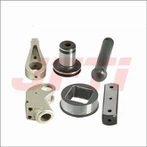
Titanium plastic processing is the process of processing titanium ingots into semi-finished products by plastic deformation. It is one of the manufacturing processes of titanium materials. Common industrial processes such as forging, rolling, extrusion and stretching can produce plates, rods, wires, tubes, and forgings of various specifications. The characteristics of titanium plastic processing are large deformation resistance, low plasticity at room temperature, high ratio of yield limit to strength limit, large deformation resilience, and easy adhesion to the mold during deformation. The deformation resistance of the heated titanium material decreases with the increase of temperature, and the plasticity increases with the increase of temperature.
Especially for high-alloy iron alloys, heating deformation is the main deformation method. Heating is a necessary process before ingot forging. Titanium has poor thermal conductivity. During the heating process, the heating speed must be controlled to prevent the formation of large thermal stress in the ingot. For some high-alloy ingots, this thermal stress may cause cracking. The heating time of the resistance furnace or flame furnace is generally calculated according to the section size of 1min/mm. High-alloy ingots are slower.
Therefore, segmented heating is often used. If induction heating is used, the time required will be significantly reduced. Titanium materials are highly chemically active and easily absorb oxygen, nitrogen, and hydrogen when heated. When heated in air, an oxide scale and the gettering layer will be formed on the surface of the blank. If the getter layer is too thick, it will crack when deformed, resulting in deterioration of product quality. When the titanium material absorbs hydrogen more than the standard value, the hydrogen may generate hydrogen in future use. In order to reduce hydrogen, nitrogen, hydrogen, hydrogen, and hydrogen during heating. In order to protect the local heating of the titanium material, if an electric furnace is used for heating, it is best to use a certain method to remove the oxide scale and gettering layer.
Titanium plastic processing. Forging is a necessary process for processing titanium ingots into intermediate billets and is generally called billet forging. At the same time, forging is also an independent process for producing bars, forgings, die forgings, and other products. Forging equipment generally uses forging hammers or hydraulic presses, but also fast forging machines and precision forging machines. The temperature of billet forging is generally selected in the β phase zone, and in the future forging should be selected in the upper part of the a-β phase zone. The deformation of fire is about 30%~70%. In view of the sensitivity of titanium alloy properties to the structure, the formulation of the forging process should be able to create the best recrystallization conditions to obtain the best overall performance of the structure. When titanium material is deformed by heating, the influence of deformation heat is great.
The heat r generated in the local strong deformation zone will cause local overheating under the influence of low thermal conductivity, which will deteriorate the structure. However, if the deformation speed can be controlled to make the deformation uniform, the deformation heat is very beneficial to the processing. The deformation resistance during the forging process increases rapidly with the increase of the deformation speed. When forging at the same temperature, the energy required for forging is higher than that of a hydraulic press. In recent years, the energy in the forging process has also affected the plasticity of the material.
In addition to recent years, forging technology has also developed. The extrusion method can produce pipes, bars, and profiles. Titanium material tends to stick to the mold when it is extruded. If the lubrication is not good, it will not only damage the mold but also cause longitudinal groove defects on the surface of the extruded part. A commonly used lubrication method is to apply glass lubricant metal sleeve or graphite-based lubricant. There are three methods for rolling plate, strip, and foil: hot rolling, warm rolling, and cold rolling. Except for p-type titanium alloys, hot rolling should generally be around n or a-B phase g-i.
The hot rolling temperature is 50~100℃ lower than the forging temperature. Plates with a thickness of 2 to 5 ram can be warm-rolled, and thinner plates can be cold-rolled. The deformation of the two annealing chambers during the cold rolling process is 15% to 60%. In order to ensure the quality of the plate and the smooth progress of the rolling process, process measures such as intermediate annealing and surface treatment should be adopted. Strip rolling, continuous pickling, continuous annealing, and other units can produce several tons of titanium coils per coil.
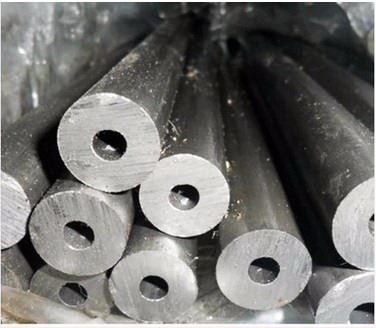
Thick-walled pipe rolling can be produced by extrusion or cross-rolling, and small-diameter thin-walled seamless pipes need to be cold-rolled or stretched. Titanium alloys have limited plasticity in the cold state, are sensitive to notches, are easy to work hardening, and are easy to stick to molds. The warm rolling process can be used to improve the rolling performance of the titanium alloy tube. The quality of the pipe largely depends on the ratio of the wall thickness reduction rate to the diameter reduction rate. When the former is greater than the latter, high-quality pipes can be obtained.
In addition, the rolled thin strip coils are used as blanks, which are cut, coiled, and welded into thin-wall welded pipes in the pipe welding machine series. They have also been widely used in electric power, chemical, and other fields. Profile rolling can produce bars and simple cross-section profiles. Compared with steel, titanium material has a larger elongation coefficient during pass rolling. Stretching can produce pipes, small diameter rods, and silk. In order to prevent mold adhesion, the blank is usually treated with phosphate or oxidation before stretching. Graphite, molybdenum disulfide, or lime-based lubricants should be applied during stretching. In order to improve the quality of silk, reduce the stretching force, and extend the life of the mold, pressurized molds and ultrasonic stretching can be used. Spinning has outstanding advantages in manufacturing large-diameter seamless thin-walled titanium tubes.