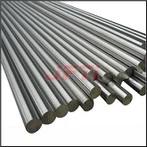
Titanium is a chemical element with the symbol Ti and atomic number 22. Sometimes called the “space age metal”, it has a low density and is a strong, lustrous, corrosion-resistant (including sea water, aqua regia and chlorine) transition metal with a silver color.
Titanium was discovered in England by William Gregor in 1791 and named by Martin Heinrich Klaproth for the Titans of Greek mythology.
The element occurs within a number of mineral deposits, principally rutile and ilmenite, which are widely distributed in the Earth’s crust and lithosphere, and it is found in almost all living things, rocks, water bodies, and soils. The metal is extracted from its principal mineral ores via the Kroll process or the Hunter process. Its most common compound, titanium dioxide, is a popular photocatalyst and is used in the manufacture of white pigments. Other compounds include titanium tetrachloride (TiCl4), a component of smoke screens and catalysts; and titanium trichloride (TiCl3), which is used as a catalyst in the production of polypropylene).
Titanium can be alloyed with iron, aluminium, vanadium, molybdenum, among other elements, to produce strong lightweight alloys for aerospace (jet engines, missiles, and spacecraft), military, industrial process (chemicals and petro-chemicals, desalination plants, pulp, and paper), automotive, agri-food, medical prostheses, orthopedic implants, dental and endodontic instruments and files, dental implants, sporting goods, jewelry, mobile phones, and other applications.
The two most useful properties of the metal form are corrosion resistance and the highest strength-to-weight ratio of any metal. In its unalloyed condition, titanium is as strong as some steels, but 45% lighter. There are two allotropic forms and five naturally occurring isotopes of this element, 46Ti through 50Ti, with 48Ti being the most abundant (73.8%). Titanium’s properties are chemically and physically similar to zirconium, because both of them have the same number of valence electrons and are in the same group in the periodic table.

Grades of Titanium
The grades of titanium vary depending on the metal alloy. Titanium grades show how much resistance the metal has in relation to the strength. Although titanium is durable in its purest form, once it’s combined with other elements it becomes stronger.
Grade 1 titanium is titanium in its purest form. Compared to grade 5 titanium, grade 1 has less ductility to offer.
Of all alloys, grade 5 titanium is the one which is used most. Titanium grade 5 has an exceedingly high strength making it more reliable under extreme conditions. This type of titanium is normally associated with aerospace and marine industries because it can withstand temperatures up to 600°F.
Titanium grade 12 has greater resistance against heat which makes it particularly useful for tube heat exchangers. This type of titanium is perfect for welding because it offers high strength stability.
Titanium Grade 1-4 is pure Titanium, the other grades are alloys. Pure Titanium is used due to it’s high corrosion resistance, the alloys because of the extremely high strength to weight ratio.
Grade 1 Pure Titanium, relatively low strength and high ducility. Plate heat exchangers
Grade 2 The pure titanium most used. The best combination of strength, ducility and weldability. Piping systems.
Grade 3 High strength Titanium, used for Matrix-plates in shell and tube heat exchangers.
Grade 5 The most manufactured titanium alloy. Exceedingly high strength. High heat resistance. Aerospace, subsea.
Grade 7 Superior corrosion resistance in reducing and oxiding enviroments. Chemical Industry.
Grade 9 Very high strength and corrosion resistance. Hydraulic piping, subsea.
Grade 11 Applications as for gr 7. Suitable for deep drawing.
Grade 12 Better heat resistance than pure Titanium. Applications as for grade 7 and 11. Shell and tube heat exchangers.
Titanium Qualities
Outstanding corrosion resistance
Superior strength-to-weight ratios
Low density
High heat-resistance
High heat transfer capability
Very good oxidation capabilities
High melting point
Low elasticity module
Excellent erosion resistance
Low thermal expansion coefficient
| CHEMICAL, PHYSICAL AND MECHANICAL PROPERTIES | ||||||
| CHEMICAL COMPOSITION | ||||||
| ASTM grade | ||||||
| (Max. Values) | 1 | 2 | 5 | 7 | 9 | 12 |
| N, Nitrogen | 0,03 | 0,03 | 0,05 | 0,03 | 0,02 | 0,03 |
| C, Carbon | 0,1 | 0,1 | 0,1 | 0,1 | 0,05 | 0,08 |
| H, Hydrogen | 0,015 | 0,015 | 0,0125 | 0,015 | 0,013 | 0,015 |
| Fe, Iron | 0,2 | 0,3 | 0,4 | 0,3 | 0,25 | 0,3 |
| O, Oxygen | 0,18 | 0,25 | 0,20 | 0,25 | 0,12 | 0,25 |
| Pd, Palladium | 0,12-0,25 | |||||
| Al, Aliminium | 5,5-6,75 | 2,5-3,5 | ||||
| Mo, Molybdenum | 0,2-0,4 | |||||
| V, Vanadium | 3,5-4,5 | 2,0-3,0 | ||||
| Ni, Nickel | 0,6-0,9 | |||||
| Ti, Titanium | Bal. | Bal. | Bal. | Bal. | Bal. | Bal. |
| PHYSICAL PROPERTIES | ||||||
| Density (g/cm3) | 4,51 | 4,51 | 4,43 | 4,51 | 4,48 | 4,51 |
| Coeff. of thermal expansion | ||||||
| 20-200 0C (10 -6/C) | 9,1 | 9,1 | 9,9 | 9,1 | 9,8 | 9,9 |
| Melting point (0C) | 1671 | 1660 | 1760 | 1660 | 1704 | 1660 |
| Modulus of Elasticity | ||||||
| (Gpa=10 9 N/mm2) | 102,7 | 102,7 | 113,7 | 102,7 | 103,4 | 103,40 |
| Thermal Conductivity, | ||||||
| at room temp. (W/m0C) | 17,11 | 18,06 | 7,41 | 18,06 | 8,35 | 20,91 |
| Specific heat (J/kg 0C) | 5,9 | 5,9 | 5,65 | 5,9 | 5,44 | 5,44 |
| Electrical resistivity | ||||||
| ( omegamm2/m) at 20 0C | 0,47 | 0,48 | 1,71 | 0,48 | 1,25 | 0,45 |
| MECHANICAL PROPERTIES | ||||||
| Tensile strength, min (Mpa) | 240,00 | 345,00 | 895,00 | 345,00 | 620,00 | 483,00 |
| Yield strength, 0,2% | ||||||
| Offset, min (Mpa) | 170,00 | 275,00 | 825,00 | 275,00 | 483,00 | 345,00 |
| Elongation (in 4D, min, %) | 24,00 | 20,00 | 10,00 | 20,00 | 15,00 | 18,00 |
| Reduction of Area, min, % | 30,00 | 30,00 | 25,00 | 30,00 | 25,00 | 25,00 |
| Hardness | Rb70 | Rb80 | Rc36 | Rb80 | Rc28 | Rc17* |
| * Interpolated |