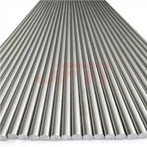
Effect of microstructure morphology on properties of TC4 titanium alloy bars
TC4 titanium alloy is one of the most widely used α+β titanium alloys, and its consumption accounts for more than 50% of the total titanium alloy consumption. Because of its corrosion resistance, high strength, heat resistance, heat treatment strengthening and non-magnetic properties, it is widely used in various fields such as aerospace, chemical industry, medical equipment and sports equipment [1-2].
In the actual production process, due to the influence of alloy composition, processing technology, heat treatment status and other factors, the micro structure of TC4 titanium alloy is diverse, and the microstructure morphology directly affects the service performance of the product, so it is of great significance to study the systematic comparison between the microstructure and mechanical properties. The effect of microstructure morphology on mechanical properties of TC4 titanium alloy bars at room temperature was investigated.
Experimental materials and methods
1.1 Experimental materials
In this experiment, the TC4 diameter forged bar with a specification of ф 35mm was selected as the material, and the TC4 titanium alloy bar with a specification of ф 10mm was prepared by heating, rolling, stretching, heat treatment and other processes. Four kinds of test bars with different microstructure and morphology were prepared by proper process control during the experiment. The chemical composition is shown in Table 1.
1.2 Experimental methods
The billets were held at 750℃ for 1 hour, and the microstructure and mechanical properties at room temperature were tested after AC heat treatment.
The microstructure was detected by ZEISS optical microscope and graded according to GB/T13810-2007 rating chart. Tensile properties at room temperature were tested by WDW-50 electronic universal testing machine, and the test method was strictly in accordance with the relevant requirements of GB/T228.
Expermental Results
2.1 Microstructure and mechanical properties
The microstructure morphology of φ 10mm and TC4 titanium alloy bars after processing is shown in Figure 1. The microstructure morphology of the materials can be divided into four types. The first type is fine equiaaxial α phase grains with uniform distribution, the primary α phase content is more than 95%, and the microstructure grading conforms to the A2 level in the attached figure of GB/T13810-2007. The second type is the larger α phase grains with uniform distribution and more β transformation morphology. The primary α phase is about 50%, and the structure grade conforms to the standard GB/T13810-2007 attached figure A5. The lamellar structure of class ⅲ is composed of lamellar α phase with discontinuous grain boundary α phase, and the grade of the lamellar structure is beyond the standard requirements. The fourth type is typical Weidner structure with intact primary grain boundary.
2.2 Experimental analysis
FIG. 2 shows the comparison of tensile strength and plasticity of the above billets at room temperature.
It can be seen from the figure that the smaller the grain size of the microstructure is, it has the advantages of high strength and high plasticity. In addition, with the growth of the grain size of the material, the tensile strength and yield strength decrease, and the elongation and area shrinkage also decrease. After the primary α phase was completely absorbed, the plastic index of the sample with lamellar structure of class ⅲ decreased obviously, and the plastic index of the sample with structure morphology of class ⅳ weistenite decreased more significantly.
This is because the smaller the grain size of metal, the more grains contained in unit volume, the larger the area of grain boundary where dislocation and microdefects are concentrated, the greater the resistance to plastic deformation. Furthermore, the smaller the grain size, there are more grains with different orientations around the grain, and the greater the mutual restraining force during deformation and sliding, so that the deformation resistance during tensile deformation at room temperature is greater.
Fine grain structure has higher strength index, and its plasticity index is also high, because the smaller the grain, the more grains per unit volume, the deformation can be dispersed in more favorable sliding grains. Therefore, the metal plastic deformation is more uniform, because of uniform deformation, it is not easy to produce excessive stress concentration, so that more crystals can withstand larger plastic deformation without fracture, and the finer the grain, the better the plasticity.
In addition, the plastic properties of the samples with lamellar and weistenite structures are significantly reduced, which is due to the fact that the original grains of the samples are larger than those of other types of structures and the presence of net-like grain boundary α phase.
Conclusion
(1) The smaller the microstructure grain, it has the advantages of high strength and high plasticity, and its comprehensive performance indexes are better than coarse crystal materials.
(2) The plasticity index of the materials with lamellar structure and weistenite structure decreases sharply at room temperature.