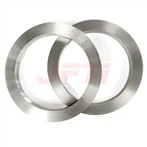
As we all know, precision machining in the aerospace industry has high requirements for materials, of course, to meet the particularity of aviation equipment, and more importantly, because of the environmental impact of aerospace. Because of the special environmental impact, the general materials on the market certainly cannot meet the needs of the environment, and some special materials are bound to be replaced. Today I will introduce a more commonly used material, that is, titanium alloy, especially in aerospace, it is more common, why is this material used more often? That has something to do with its characteristics.
Titanium alloy, its small specific gravity determines a series of excellent physical and mechanical properties such as low mass, high strength and thermal strength, hardness and high-temperature resistance, and resistance to seawater and acid and alkali corrosion, which determines its environment no matter what kind of environment it is used in. All can be used, and another point, the deformation coefficient is very small, so it has been widely used in aerospace, aviation, shipbuilding, petroleum, chemical, and other industries.
It is precise because of the above differences between titanium alloys and ordinary materials that it is also very difficult to process precision materials. Many machining factories are reluctant to process such materials and do not know how to process them. . To this end, after a long-term understanding and communication with some titanium alloy processing customers, Suien Lubricant has organized some small skills to share with you!
Due to the small deformation coefficient of titanium alloy, high cutting temperature, large tooltip stress, and serious work hardening, the tool is easy to wear and chip during cutting, and the cutting quality is difficult to guarantee. So how to do cutting?
When cutting titanium alloys, the cutting force is not large, the work hardening is not serious, and it is easy to obtain a better surface finish, but the thermal conductivity of titanium alloys is small, the cutting temperature is high, the tool wear is large, and the tool durability is low. Small chemical affinity, high thermal conductivity, high strength, small grain size tungsten-cobalt carbide tools, such as YG8, YG3, and other tools. In the process of turning titanium alloys, chip breaking is a difficult problem in processing, especially the processing of pure titanium. In order to achieve the purpose of chip breaking, the cutting part can be ground into a full-arc curling groove, which is shallow at the front and deep at the back, and narrow at the front. The width of the back makes the chips easy to discharge outwards so that the cutting eyebrows will not wrap around the surface of the workpiece and cause scratches on the surface of the workpiece.
Titanium alloy cutting deformation coefficient is small, the contact area between the knife and the eyebrow is small, and the cutting temperature is high. In order to reduce the generation of cutting heat, ① the rake angle of the turning tool should not be too large, and the rake angle of the carbide turning tool is generally 5-8 degrees, Due to the high hardness of titanium alloy, in order to increase the impact strength of the turning tool, the clearance angle of the turning tool should not be too large, generally 5°, in order to strengthen the strength of the tip part, improve the heat dissipation conditions, and improve the impact resistance of the tool ability, the use of a large absolute value of the negative edge inclination.
Controlling a reasonable cutting speed should not be too fast, and using special cutting fluid for titanium alloys to cool during processing can effectively improve tool durability and select a reasonable feed rate.
Drilling is also commonly used. It is difficult to drill titanium alloys, and the phenomenon of knife burning and drill breaking often occurs during the processing. The main reasons are the poor sharpening of the drill bit, the untimely brow discharge, poor cooling and poor rigidity of the processing system, etc. caused by various reasons. Depending on the diameter of the drill bit, the chisel edge is narrowed, and the width is generally 0.5m, in order to reduce the axial force and reduce the vibration caused by resistance. At the same time, at a distance of 5-8mm from the tip of the drill bit, the margin of the drill bit is narrowed, leaving about 0.5mm, which is conducive to the chip removal of the drill bit. The geometric shape must be sharpened correctly, and the two cutting edges must be kept symmetrical, which can prevent the drill from cutting only one edge, and the cutting force is all concentrated on one side, which will cause the drill to wear prematurely and even cause chipping due to slippage. Always keep the blade sharp, when the blade becomes dull, stop drilling immediately and re-sharpen the bit. If you continue to forcibly cut with a dull bit, the bit will soon be burned and annealed due to high friction and high temperature, causing the bit to be scrapped. At the same time, the hardened layer of the workpiece is thickened, which increases the difficulty of re-drilling and the number of times of grinding the drill bit. According to the requirements of drilling depth, the length of the drill bit should be shortened as much as possible, and the thickness of the drill core should be increased to increase the rigidity and prevent the edge from chipping due to vibration during drilling. It has been proved by practice that the drill bit of φ15 has a longer life of 150 than that of 195. So the choice of length is also very important.
After the above two common processing, the processing of titanium alloy is relatively difficult, but after good processing, it is still possible to process good precision parts, titanium alloy parts of aerospace equipment.