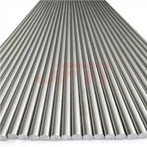
Titanium alloy smelting methods are generally divided into 1. Vacuum consumable electric arc furnace smelting method; 2. Non-consumable vacuum electric arc furnace smelting method; 3. Cold hearth smelting method; 4. Cold pot smelting method; 5. Electroslag smelting Five methods of law.
1. Vacuum consumable electric arc furnace smelting method (referred to as VAR method)
With the development of vacuum technology and the application of computers, the VAR method has quickly become a mature industrial production technology for titanium. Today's titanium and its alloy ingots are mostly produced by this method. The salient features of the VAR method are low power consumption, high melting speed, and good quality reproducibility. The ingot smelted by the VAR method has a good crystal structure and uniform chemical composition. Usually, the finished ingot should be made by the VAR method. It must be remelted at least twice. In the production of titanium ingots by the VAR method, the processes used by manufacturers around the world are basically similar, but the difference lies in the use of different electrode preparation methods and equipment. Electrode preparation can be divided into three categories. One is the use of a monolithic electrode that is continuously pressed by portion feeding, eliminating the electrode welding process; the second is single-piece electrode pressing and tailor-welded to form consumable electrodes. It is welded into a hole by plasma argon arc welding or vacuum welding; the third is to use other smelting methods to prepare casting electrodes.
The technical features and advantages of modern advanced VAR furnace:
(1) Full coaxial power input, that is to say, the complete coaxially at the height of the entire furnace body, called coaxial power supply, to reduce the occurrence of segregation;
(2) The electric calibration in the crucible can be fine-tuned on the X-axis/Y-axis;
(3) It has an accurate electrode weighing system, and the melting rate is automatically controlled, realizing constant speed of melting. Ensure the quality of smelting;
(4) Ensure the repeatability and consistency of each smelting;
(5) Flexibility, that is, one furnace can produce a variety of ingot types and the large-scale ingot can greatly increase productivity;
(6) has good economic efficiency. The "coaxial power supply" method can avoid the magnetic leakage caused by the imbalance of the crucible supply current. Reduce or eliminate the adverse effect of the induced magnetic field on the smelted product. And the electrical efficiency is improved, thereby obtaining ingots with stable quality. The purpose of "constant speed smelting" is to improve the quality of ingots. The advanced electronic control system and weight sensor are used to ensure that the arc length and melting rate are constant during the smelting process, thereby controlling the coagulation process. It can effectively prevent segregation and ensure the inherent quality of the ingot. In addition to the above two characteristics, modern VAR furnaces for titanium smelting have also achieved large-scale VAR furnaces. Modern VAR furnaces can melt large ingots with a diameter of 1.5m and a weight of 32t. The vAR method is a standard industrial smelting method for modern titanium and titanium alloys. The following technologies need to be solved. First, the electrode preparation method. The electrode preparation process is very cumbersome. It is necessary to use an expensive press to press the sponge titanium, the intermediate alloy, and the return residual material into an integral electrode or a single small electric switch. The monolithic electrode also needs to be welded into a consumable electrode. At the same time, in order to ensure the uniformity of the consumable electrode composition, it is also necessary to configure corresponding facilities such as cloth, weighing, and mixing. Second, there are occasional metallurgical defects such as segregation. Such as component segregation and solidification segregation. www.lh-ti.com introduces the former due to the uneven distribution of impurity elements or alloying elements in the electrode. During smelting, it is caused by solidification before a balanced distribution; the latter is caused by the occasional introduction of high-density inclusions (HDI) and low-density inclusions (LDI) in the raw materials or the process. These inclusions cannot be completely dissolved during the smelting process, thus Leading to metallurgical defects such as extremely harmful inclusions.
2. Non-consumable vacuum arc furnace melting method (Jane NC method)
At present, the water-cooled copper electrode has replaced the tungsten-thorium alloy or graphite electrode in the initial stage of the titanium industry, and solved the problem of industrial pollution, making the NC method an important method for smelting titanium and titanium alloy. NC furnaces are already in operation in Europe and America. Water-cooled copper electrodes are divided into two types: one is self-rotating; the other is a rotating magnetic field, the purpose of which is to prevent the burning of the electrode by the arc. NC furnaces can also be divided into two types: one is to smelt raw materials in a water-cooled copper crucible and cast them into ingots in a water-cooled copper mold; the other is to continuously put raw materials in a water-cooled copper crucible, smelt and solidify. The advantages of NC method smelting are: ① It can save the steps of pressing electrodes and welding electrodes; ② It can make the arc stay on the material for a long time, thereby improving the uniformity of the ingot composition; ③ It can use raw materials of different shapes and sizes. 100% residual material can be added during the smelting process to realize the recycling of titanium. As a primary smelting, the NC method is quite advantageous in terms of increasing the recovery rate of residual materials and reducing costs. Usually, NC furnace and VAR furnace are used in combination to give full play to their respective advantages.
3. Cold hearth smelting method (referred to as CHM method)
The metallurgical inclusion defects of titanium and titanium alloy ingots caused by the pollution of raw materials and abnormal smelting process have always affected the application of titanium and titanium alloy in the aerospace field. In order to eliminate metallurgical inclusions in the rotating parts of titanium alloy aircraft engines, cold hearth smelting technology came into being. The biggest feature of the CHM method is the separation of melting, refining and solidification processes, that is, the molten charge enters the Ling hearth and is first melted, then enters the refining zone of the cold hearth for refining, and finally solidifies into an ingot in the crystallization zone. The significant advantage of CHM technology is that a condensed shell can be formed on the wall of the cold hearth, and its "viscous zone" can capture high-density inclusions (HDI) such as WC, Mo, and Ta. At the same time, in the refining zone, low-density inclusions The longer residence time of (LDI) particles in a high-temperature liquid can ensure the complete dissolution of LDI, thereby effectively removing inclusion defects. That is to say. The purification mechanism of cold hearth smelting can be divided into two types: specific gravity separation and melting separation.
3.1 Electron beam cold hearth smelting method (EBCHM method for short) Electron beam smelting (EB for short) is a process that uses the energy of high-speed electrons to generate heat from the material itself for smelting and refining. An EB furnace with a cold heart is called EBCHM. The EBCHM method has excellent functions that the traditional smelting method does not have:
(1) Effectively remove tantalum, molybdenum, tungsten, tungsten carbide, and other high-density inclusions (HDI) and titanium nitride. Low-density inclusions such as titanium oxide (LDI);
(2) It can accept a variety of feeding methods, and the recovery of titanium residues is relatively easy, that is, waste materials that cannot be used by other smelting methods can be used, and pure titanium ingots can be produced, which greatly reduces the cost of the product;
(3) It can be directly sampled and analyzed from molten metal;
(4) Ability to produce special-shaped ingots, reduce production procedures, reduce raw material consumption, and increase yield;
EBCHM method also has the following shortcomings:
(1) The smelting needs to be carried out under high vacuum conditions, so it is not possible to directly smelt titanium sponge with higher chloride content;
(2) Alloying elements are volatile and it is difficult to control the chemical composition.
3.2 Plasma cooling bed smelting method (called PCHM method in short)
PCHM method uses the plasma arc generated by the ionization of inert gas as the heat source and can complete the smelting in a wide pressure range from low vacuum to near atmospheric pressure. The salient feature of this method is that it can guarantee the alloy components of different vapor pressures. There is no obvious in the smelting process. This method has the ability to improve the metal properties of traditional Taiwan and can realize the smelting of diversified alloys. It is an economical method than traditional smelting methods. The smelting method. With this method of smelting, for titanium and titanium alloys, an ideal ingot can be obtained by one smelting. www.lh-ti.com The advantages of the modern PCHM method are:
①Equipment investment is low, easy to operate, safe, and reliable;
②Different types and forms of raw materials can be used, and the recovery rate of residual materials is high;
③Ensure the chemical composition of diversified alloys;
④ It realizes the recovery and reuse of expensive inert gas and reduces the production cost. The disadvantage of the PCHM method is low electrical efficiency. EBCHM and PCHM are similar in that both can eliminate HDI and LDI. Generally, the former is more suitable for smelting pure titanium; while for alloys, the latter is more suitable. Like the VAR method, the above two methods realize a wide range of process automation control, including process parameters (melting speed, temperature distribution during smelting and solidification, changes in composition during smelting, degree of removal of insoluble inclusions, etc.) and quality.
4. Cold crucible melting method (abbreviated as CCM method)
In the 1980s, the American Ferrosilicon Company developed a slag-free induction smelting process and promoted the CCM method to industrial production applications for the production of titanium ingots and titanium precision castings. In recent years, in some economically developed countries, the CCM method has begun to step into the scale of industrial production. The maximum diameter of the ingot is 1 m and the length is 2 m. Its development prospects are eye-catching. The CCM smelting process is carried out in a metal crucible composed of water-cooled arc blocks or copper tubes that are not conducive to each other. The biggest advantage of this combination is that the gap between every two blocks is an enhanced magnetic field, which generates a strong magnetic field. Stirring makes the chemical composition and temperature consistent, thereby improving product quality. The CCM method has the characteristics of both the VAR method and the induction melting of refractory materials in the crucible. It does not require refractory materials and does not need to make electrodes to obtain high-quality ingots with uniform composition and no crucible contamination. Compared with the VAR method, the CCM method has the advantages of low equipment cost and simple operation, but from the current point of view, the technology is still in the development stage.
5. Electroslag smelting method (abbreviated as ESR method)
The ESR method uses the collision of charged particles when the current passes through the conductive electro slag to convert electrical energy into heat. That is, the charge is melted and refined by the heat energy generated by the slag resistance. The ESR method uses consumable electrodes for electroslag smelting in inactive slag (CaF2), which can be directly fused and cast into ingots of the same shape, and has good surface quality, which is suitable for direct processing in the next process. The advantages of this method are:
(1) The complete coaxially of the ESR furnace ensures the repeatability of the best quality ingots;
(2) The ingot crystallizes axially, and the structure is dense and uniform;
(3) Electrode weighing system and melting rate control system with extremely high precision;
(4) The equipment is simple and easy to operate. The disadvantage is that the contamination of the ingot by the molten slag cannot be discharged.