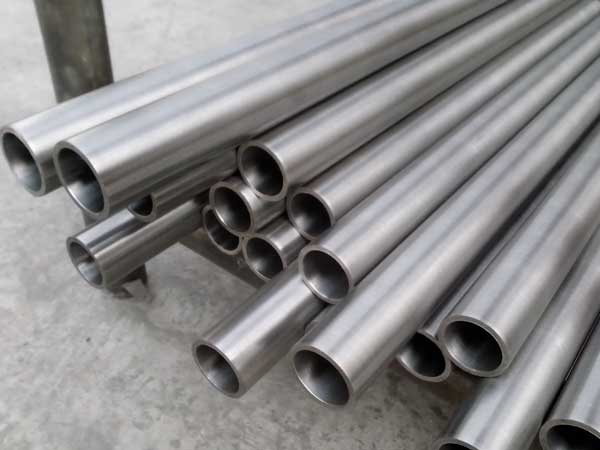
After a large number of tests and application examples, it has been proved that the application of titanium tubes in power plant condensers has great technical and economic advantages. In terms of economy, take the pipe diameter price of a 1000Mw condenser nuclear power unit in Japan (approximately 50,000 condenser tubes) as an example, using the condenser 40 years of service time, the average annual leakage of aluminum and copper pipes is 10 Root, and the titanium tube has no leakage in 40 years. This article mainly discusses the problems existing in the application of titanium tubes in power stations.
1. Corrosion problem
Seawater is used as cooling water for condensers in coastal power stations. Since seawater contains a large amount of sediment, suspended matter, marine organisms, and various corrosive substances, the situation is more serious in brackish water where seawater and river water alternate. Traditional copper platform metal pipes' corrosion methods include overall corrosion (uniform corrosion), erosion, and stress corrosion. Because titanium has excellent corrosion resistance, it eliminates seawater leakage accidents caused by corrosion of the titanium tube condenser. However, because titanium tubes do not have good corrosion resistance like copper alloy tubes, toxic substances are generated on the surface. Therefore, marine organisms easily adhere to the inner wall of the titanium tube and affect the heat transfer effect. Therefore, a corresponding cleaning device is required.
2. Hydrogen absorption problem
Although there is a dense passivation film on the surface of titanium, which is very resistant to corrosion in many strong corrosive media, the affinity between titanium and hydrogen is very high. It is very easy to absorb hydrogen. It occurs at room temperature and rapidly absorbs hydrogen at high temperatures (such as 100°C). The solid solution limit of hydrogen in titanium is very small (about 20 ppm). If the limit is exceeded, hydride (TtH2) will precipitate on the titanium surface. As the titanium content on the surface increases, the impact value and elongation of titanium drop rapidly. In addition, during the renovation of the old unit, since the tube sheet is made of copper alloy and the condenser tube is made of titanium, it is necessary to use a cathodic protection device to prevent electrochemical corrosion. For example, the condenser of Hitachi Power Plant is cooled by seawater, and titanium tubes are paired with copper alloy plates. When the protection potential is lower than 0.75 v (SE), the end of the outlet titanium tube absorbs hydrogen, and the hydrogen content reaches 650ppm after one year of use. If the potential is 0.5 ~ 0.75 V (SCE), titanium will not absorb hydrogen at room temperature.
3. Vibration problem
The titanium pipe has good corrosion resistance. The titanium condenser will not be damaged by corrosion and leakage, but the titanium tube may be damaged by vibration. In order to avoid the vibration problem of the titanium tube, it is necessary to determine the appropriate partition spacing when manufacturing the titanium condenser; when the old unit is reformed, it is necessary to investigate whether the original partition spacing is suitable for the titanium tube.