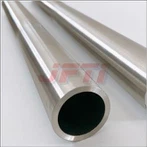
The surface reaction layer of titanium plate and titanium rod is the main factor affecting the physical and chemical properties of titanium workpiece. Before processing, the surface pollution layer and defect layer must be completely removed. Physical and mechanical polishing of titanium plate and titanium rod surface polishing process:
Sandblasting:
The sandblasting treatment of titanium wire castings is generally better to use white corundum, and the pressure of sandblasting is smaller than that of non-precious metals, generally controlled below 0.45MPa. Because, when the injection pressure is too large, the sand particles impact the titanium surface to generate intense sparks, and the temperature rise can react with the titanium surface, resulting in secondary pollution and affecting the surface quality. The time is 15-30 seconds, and only the sticky sand, surface sintered layer and part of the oxide layer on the surface of the casting can be removed. The rest of the surface reaction layer structure should be quickly removed by chemical pickling.
2. Pickling:
Pickling can quickly and completely remove the surface reaction layer, and the surface will not be contaminated by other elements. Both HF-HCL series and HF-HNO3 series pickling solutions can be used for titanium pickling, but HF-HCL series pickling solutions have a large amount of hydrogen absorption, while HF-HNO3 series pickling solutions have a small hydrogen absorption capacity, which can control HNO3 The concentration of HF can reduce the absorption of hydrogen, and the surface can be brightly treated. Generally, the concentration of HF is about 3%-5%, and the concentration of HNO3 is about 15%-30%.
The surface reaction layer of titanium plate and titanium rod can be completely removed by pickling after sandblasting.
In addition to physical mechanical polishing, there are two types of reaction layers on the surface of titanium plates and titanium rods, namely: 1. Chemical polishing, 2. Electrolytic polishing.
Chemical polishing:
During chemical polishing, the purpose of leveling and polishing is achieved through the redox reaction of metal in chemical medium. The advantage is that chemical polishing has nothing to do with the hardness of the metal, the polishing area and the structural shape, and all the parts in contact with the polishing liquid are polished, no special complex equipment is required, the operation is simple, and it is more suitable for the polishing of titanium denture brackets with complex structures. However, the process parameters of chemical polishing are difficult to control, and it is required to have a good polishing effect on the denture without affecting the accuracy of the denture. A better titanium chemical polishing liquid is prepared by HF and HNO3 in a certain proportion. HF is a reducing agent, which can dissolve titanium metal and play a role in leveling. The concentration is less than 10%. HNO3 plays an oxidation role to prevent excessive dissolution of titanium and hydrogen absorption. , at the same time can produce bright effect. Titanium polishing liquid requires high concentration, low temperature and short polishing time (1-2min).
2. Electrolytic polishing:
Also known as electrochemical polishing or anodic dissolution polishing, due to the low conductivity and strong oxidation performance of titanium alloy tubes, it is almost impossible to polish titanium with aqueous acidic electrolytes such as HF-H3PO4 and HF-H2SO4 electrolytes. After the external voltage, the titanium anode is oxidized immediately, so that the anode dissolution cannot be carried out. However, the use of anhydrous chloride electrolyte at low voltage has a good polishing effect on titanium, and small specimens can be mirror polished, but for complex restorations, the purpose of complete polishing can still not be achieved. Maybe change the shape of the cathode and add an additional cathode The method can solve this problem, and further research is needed.