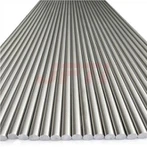
Since its entry into industrial production, titanium has been inseparable with bicycles. The application of titanium and titanium alloys in bicycles began in Japan. In 1999, the folding bicycle of the National Bicycle Industry Company was the lightest bicycle in the world at that time, its weight was only 6.5kg, and the trade name was "ToRenKuRu 6500". The bike uses both a titanium frame and industrial-grade titanium construction.
Generally, 70% to 80% of light bicycle transmission structural parts and brake parts are made of aluminum alloy, and 20% are made of steel. Titanium alloy structural parts can be used on bicycles as frame, transmission gear, brake disc, etc. At present, titanium alloy structural parts are mainly used in racing cars and high-end cars. General bicycles use 36 spokes, while titanium alloy bicycles only need 24 spokes. The reduction of the number of spokes not only reduces the quality of the car, but also reduces the wind resistance. The bicycle frame can be made of industrial pure titanium tube, or it can be made of titanium alloy Ti6Al4V, Ti6Al4VEL1, Ti3Al2.5V tube. Titanium frames are lighter than chrome molybdenum steel frames, and are more comfortable to ride and last longer. The average weight of the titanium frame produced by the American company Litespeed is only 1.5kg, but the price is more than 3500 US dollars per set. The Italian Campagnolo company uses titanium and titanium alloys to manufacture structural parts of racing cars, such as encapsulated transmission lock pins, left-hand nuts, pinless crankshafts, front and rear hub axles, left and right pedal axles, etc.
Bicycles produced in China can be found all over the world. In 2021, China's bicycle production has exceeded 80 million units, and 69.26 million bicycles have been exported, a year-on-year increase of 14.9%; the export value is 5.108 billion US dollars, a year-on-year increase of 40.2%, achieving a double jump in volume and price. Consumers of Chinese bicycles are in more than 140 countries and regions around the world, and the models are also varied, including mountain bikes, shock-absorbing bikes, road sports cars, city bikes, performance bikes, folding bikes, snowmobiles, baby bikes, electric bicycles, etc. In terms of metal materials for vehicles, steel is the main material, accounting for about 55% of the total material consumption, followed by aluminum alloys, magnesium alloys, titanium alloys, and composite materials. Although the quality of titanium and composite materials is good, they are prohibitive due to the high price. The price of the frame made of Ti3Al2 pipe is 2000~4200 US dollars per pair, and the whole bicycle is sold for about 3000~8000 US dollars. In 1985, titanium frames were not yet available; in 1990, titanium frame sales were about $1.5 million; in 1995, sales reached $5 million. Titanium frame sales are growing at a slower pace, mainly due to their high price.
The titanium alloy used in bicycles is mainly Ti3Al2.5V, which is an American titanium alloy developed for the manufacture of aircraft structures. Its Chinese grade is TAl8. The main advantages of this alloy are low yield strength, easy processing, strong corrosion resistance and high fatigue strength. It is an α-type titanium alloy. This type of titanium alloy mainly contains α-stabilizing elements. Titanium alloys of alpha phase, such as industrial pure titanium (TA0, TA1, TA2, TA3) and TA7. Alpha titanium alloy is mainly used in the manufacture of chemical, petrochemical and processing industries. When applying in the above industries, the first consideration is the corrosion resistance and machinability of the alloy. There are 4 kinds of industrial pure titanium (TA0, TA1, TA2, TA3) , its maximum impurity content is shown in Table 1, Ti3A2.5V is also an α titanium alloy, there are 7 kinds according to GB/T 3620.